
Pullers and Extractors
A puller draws bearings, gears, pulleys and belt wheels off their shaft without damaging the shaft, the hub or the part itself. The range runs from two-arm universal pullers for general workshop work to internal pullers for blind bearing seats and ball joint pullers for chassis work. Everything here is KUKKO: German tool steel, with cross-arms, jaws and spindles available separately, so one worn part does not mean a new puller.
Find your part
Select your machine to find matching parts
Parts by type
Browse through the different parts for Pullers
Universal Pullers
The workhorses of the puller range. Two or three sliding jaws that stay parallel to each other, a spindle in the middle, and a clamping range you adjust with a hex key in seconds. Reverse the jaws and the same puller works as an internal puller. Suitable for bearings, gears and pulleys in the common sizes.
View 6 partsInternal Pullers
When a bearing sits in a blind bore and there is nothing to grip from the outside, an internal puller grips the inner race instead. The shell is spread behind the bearing, after which you pull with a counterstay or slide hammer. The KUKKO range covers Ø 12 to 58 mm in seven overlapping sizes, so one always fits exactly.
View 7 partsSlide Hammers & Counterstays
An internal puller needs something to push against. That can be static, with a counterstay bracing on the housing, or dynamic, with a slide hammer knocking the bearing out using a sliding weight. Both are available separately and fit the complete KUKKO internal puller range, so you do not need a new set for every size.
View 4 partsBearing Pullers & Separators
When a bearing sits tight against a shoulder there is no room for a jaw. A separator forces a thin, ground cutting edge between bearing and shoulder and then provides a face to pull against. The Cobra series combines separator and puller in one tool, with a side clamp so the arms cannot spread under load.
View 6 partsBall Joint Pullers
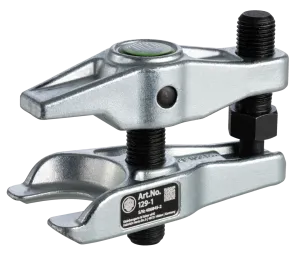
A ball joint releases under pressure, not under force. These separators brace on the steering knuckle with a lever mechanism or spindle and press the taper out — without tearing the boot or damaging the threaded stud. Sizes for passenger cars and light commercial vehicles.
View 4 partsSeparator Forks
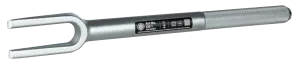
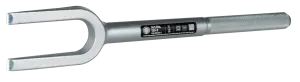
The separator fork is driven between the knuckle and the control arm and levers the ball joint apart. Crude but effective, and the fastest route on a joint that is being replaced anyway. Three fork openings cover ordinary passenger car work.
View 3 partsWiper Arm Pullers
A corroded wiper arm cannot be levered off without damaging the splined shaft — and that shaft is part of the wiper linkage, which turns it into an expensive repair. This puller clamps around the arm and presses it straight off the shaft. Universal span, fits most passenger cars.
View 1 partsPuller Sets
A set takes the guesswork out: every size that belongs together, in a case or drawer insert that fits the tool trolley. Useful for workshops that would rather not order a single size every month, and for service vans where searching costs time.
View 2 partsPuller Accessories
A mechanical spindle reaches its limit at some point. Replace it with a hydraulic spindle, or fit an auxiliary ram between spindle and shaft, and the same puller delivers up to 10 tonnes — controlled, with less effort, and without letting go suddenly.
View 2 partsWe supply parts for brands like
Original and compatible parts from all major brands












Most popular parts for Pullers
The most ordered parts by our customers
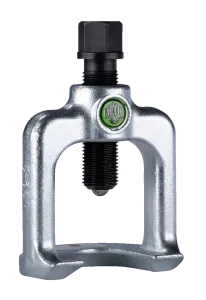
KUKKO 128-2 Ball Joint Puller, 23 mm Opening
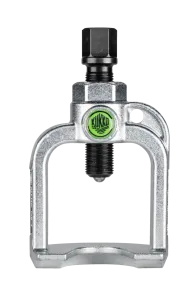
KUKKO 128-3 Ball Joint Puller, 29 mm Opening
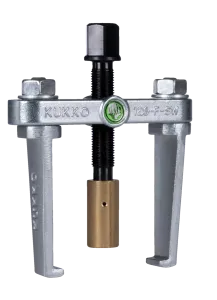
KUKKO 128-F-SW Universal Wiper Arm Puller, 60 mm
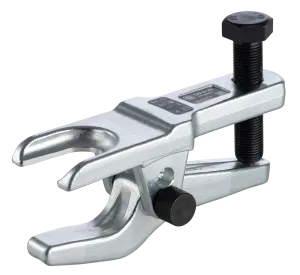
KUKKO 129-0-25 Ball Joint Puller with Lever Transmission

Useful tips for Pullers
All articles

Frequently asked questions about Pullers
Answers to the most common questions from our customers
Choosing the right puller
Choose on access first, force second. If you can reach around the part from the outside, a universal puller will do; if the bearing sits in a blind bore, you need an internal puller that grips the inner race. If the part sits tight against a shoulder, no jaw will fit between them and a separator is the only route.
Then measure the outside diameter of what has to come off and pick a clamping range comfortably around it. A puller at its maximum has its jaws pointing almost straight out and loses grip — that is the moment it lets go. Two sizes of overlap cost a few tens and save a damaged shaft.
If the spindle turns hard, do not extend it with a pipe. The jaw is rated for the tool's pulling force, not for what you can generate with a metre of leverage. A hydraulic spindle does the same work under control, and fits the tool you already have.